Home
Blog & Expertise
Company


When you buy from an overseas supplier, you are planning more than a purchase. You may be preparing stock for your warehouse, promising availability to customers, or arranging materials for a project.
A confirmed delivery date helps you make those plans, but it does not tell you where your order stands today. Has production started? What happens next? Is the schedule still on track?
I believe buyers should have clear answers to those questions without having to keep chasing them. Once you place an order, you should not lose sight of the purchase your business is depending on.
Earlier in my export career, I handled an order for an overseas wholesaler who wanted the goods shipped before Chinese New Year. As the holiday approached, orders increased, with many customers trying to catch the same shipping window.
The production schedule slipped. The customer believed their order was already being manufactured, but it was still waiting to start. By the time that difference became clear, there was little room left to adjust the plan.
The goods missed the pre-holiday shipping window, and the customer faced shortages of some products for several weeks. To help reduce the impact, we sent a batch of goods by air so they would have some stock to sell while waiting for the remaining shipment.
That was a practical way to help, but it was still a response to a problem that had already happened. We would rather identify the risk earlier and work through alternatives with the customer, instead of having to arrange a last-minute solution.
The issue was not whether the factory could make the products. The schedule had changed, but the customer’s understanding of the order had not changed with it.
That experience stayed with me. Helping a customer recover matters, but giving them more time and options before the situation becomes urgent matters too.
Since then, I have come to think of a useful update as information a buyer can act on. “We are following up” is not enough if you still cannot tell what has happened or what comes next.
For your next overseas order, these are three questions worth asking.
1. Has production started, or is my order still in the queue?
An order confirmation and a production start are different milestones. Confirming the actual stage helps you understand whether the remaining schedule is based on work already underway or work still waiting to begin.
2. What is the next milestone, and when should it be completed?
Depending on the order, this might be production completion, inspection or packing. A specific next step gives you something meaningful to follow up on before the final shipping date arrives.
3. Is anything putting our agreed shipping date at risk?
If something is uncertain, ask what still needs to be checked and when you will receive the next update. An honest “we need to confirm this” is more useful when it comes with a clear follow-up date.
It is also worth checking what your supplier means by “delivery.” Goods ready at the factory, departure from the port and arrival at your destination are different events. Make sure you are both planning around the same milestone.
From your side, explain which products are most urgent and when you need them available. A supplier can discuss more relevant options when they understand what a change would mean for your business—not just the date written on the order.
There is no single solution for every order. The first step is to identify what you need most urgently, then discuss which options are practical with your supplier. Some options may improve the schedule; others help reduce the impact of a delay.
If only a few items are close to running out, tell your supplier which products and quantities matter most. Ask whether those items can be prioritized in production, inspection and packing.
Check first: Your remaining stock, expected demand and the date you need replenishment. Confirm whether changing the production sequence is feasible and how it affects the rest of the order.
If some goods are finished, a partial shipment may let you receive usable stock while the remaining items are being completed.
Check first: Which items have passed inspection and are ready to ship, whether they are useful on their own, and the additional freight and handling costs. Agree on a separate schedule for the balance.
For selected items, a limited air shipment may help bridge a stock gap while the main shipment travels by sea. This is the approach we used in the case described above.
Check first: The minimum quantity you need, when it will actually be ready, and the estimated arrival time after customs clearance. Compare the additional cost with the business impact it may help avoid.
Ask whether your supplier has suitable stock available. If an alternative product is proposed, review it carefully before agreeing to a substitution.
Check first: Dimensions, material, compatibility and any required certifications or customer approvals. A faster shipment is only useful if the product is suitable for the job.
Before choosing a Plan B, agree on the quantities, additional costs, revised dates and who will handle each next step. Faster arrangements should not mean skipping quality checks.
At Velkor, we want to consider the order from the customer’s side. Manufacturing and shipping matter because someone is depending on those goods to keep stock available, serve their customers or move a project forward.
Our first goal is to help customers receive their goods on time. Clear order updates should support that goal throughout the process, including when everything is going according to plan.
When an unexpected problem genuinely puts the schedule at risk, we want customers to know while there is still time to respond. We can then work together on a practical Plan B, rather than leaving the customer to face a last-minute surprise.
This is one reason our team designed Velkor’s Order Tracking System: to bring as much transparency as possible to the purchasing process. It gives customers a clearer view of their order’s current stage and helps our team coordinate planning, follow-up and communication.
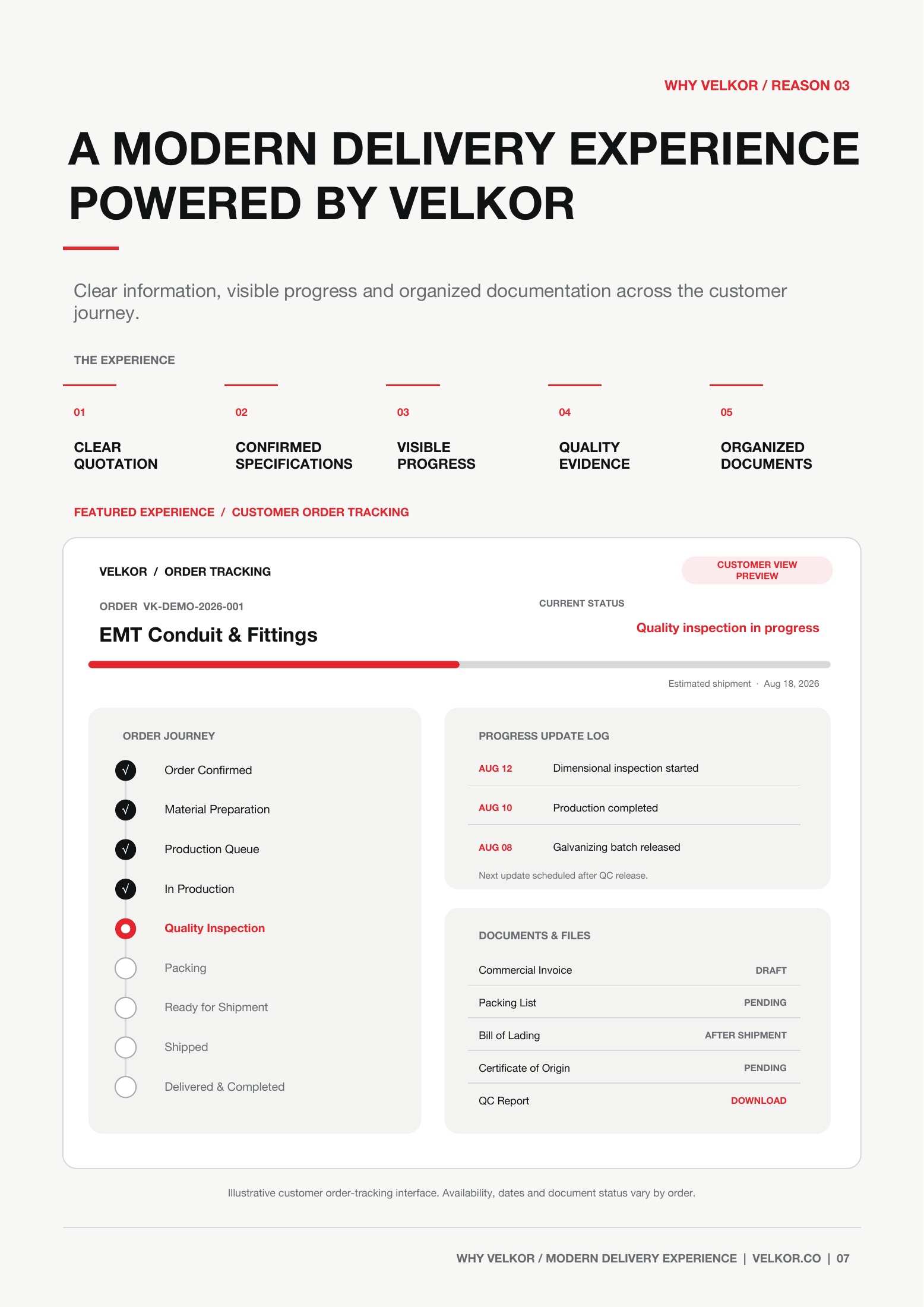
The system is now in its second version, and customer feedback is helping us improve it. But software alone is not the answer; our team still needs to keep information current, communicate honestly and act when something needs attention.
You can visit Velkor Order Tracking. If you need help accessing your order, please contact our team.
We will share a closer look at the system in a future article. The purpose behind it is simple: we want customers to receive their goods as planned—and if that plan is genuinely at risk, we want to work through the next steps with them.