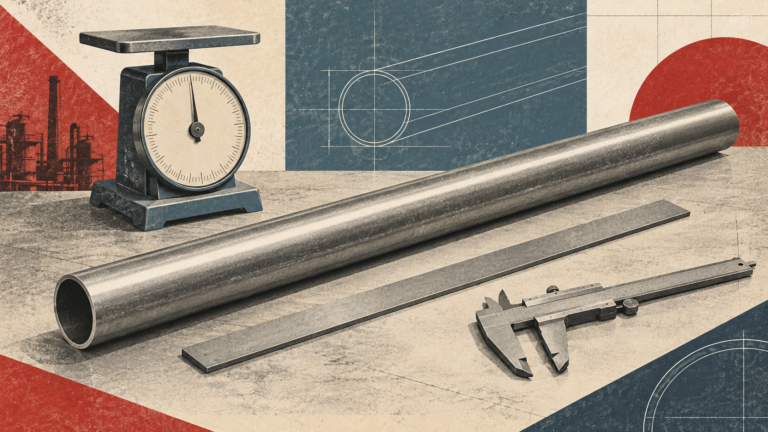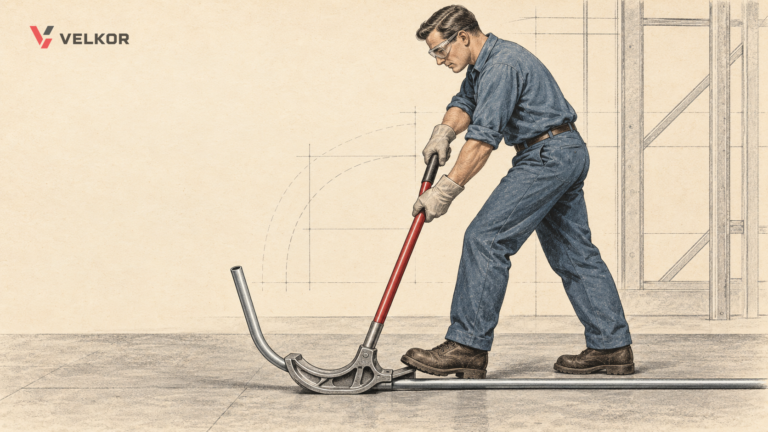
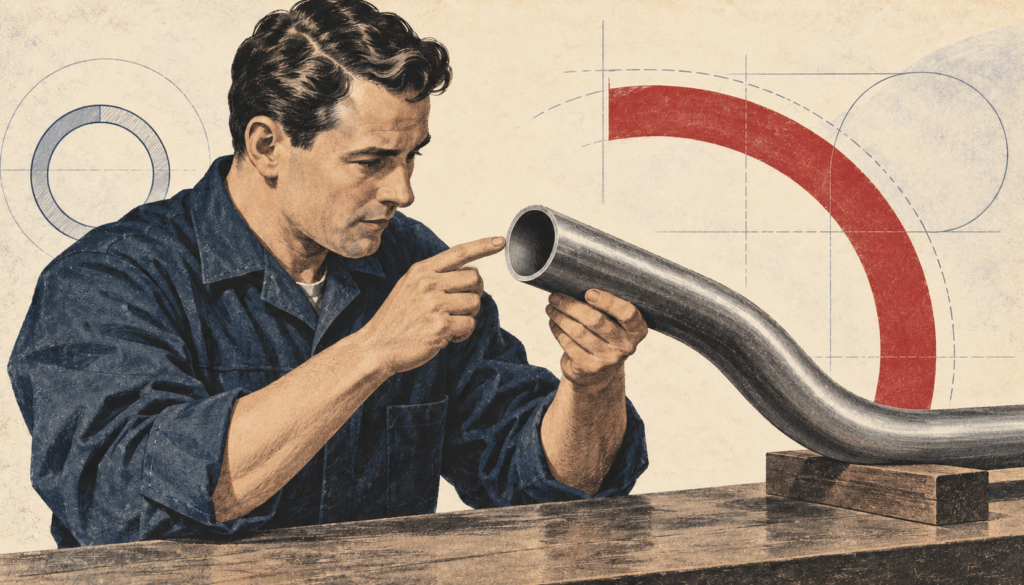
When customers request EMT with thinner walls, we need to be more careful about material selection and verify bending performance at the requested thickness. Our factory trials show why: thinner EMT may take less effort to bend, but keeping the bend round and smooth can become more difficult.
Our previous article explored how steel grades affect EMT bending. Here, we look at what happens when the wall becomes thinner.
What changes as the wall gets thinner?
In our experience, EMT made to the specified standard wall thickness generally bends well with suitable material and a correctly matched bender. In trials with thinner-wall samples, flattening and ridges along the inside of the bend begin to appear more readily.
During bending, the outside stretches and thins while the inside is compressed and can thicken.[1] Bend Tooling describes relative wall thickness using the wall factor: outside diameter divided by wall thickness (D/t). A higher ratio means a relatively thinner wall, which needs more support to resist wrinkling or collapse. Bend radius matters too.[2]
There is a trade-off: thicker walls can resist collapse better but require more bending force. Equipment specialists interviewed by Canadian Fabricating & Welding discuss both effects in thick-wall machine bending.[3]
What our DX51D trials showed
These were the lowest wall thicknesses that gave satisfactory bends in our DX51D trials:
| EMT trade size | Wall thickness | Material |
|---|---|---|
| ½ inch | 0.85 mm | DX51D |
| ¾ inch | 1.10 mm | DX51D |
| 1 inch | 1.30 mm | DX51D |
Below these thicknesses, we began encountering bending problems. These are observations from our trial conditions, not standard wall-thickness requirements or universal minimums. Results depend on the finished tube, bender, bend radius and technique; a successful bend alone does not establish standards compliance.
Material made a noticeable difference. At ¾ inch and 1.10 mm, the Q195 tubes we tried could wrinkle, while our DX51D tubes bent satisfactorily. When customers request still thinner walls, our experience indicates that suitable DX52D or DX53D material can help maintain bend quality. Performance at the requested thickness still needs to be checked on the actual tube.
How the force is applied matters too
We have found that a smooth, controlled bending motion tends to produce better results. When an operator struggles and repeatedly stops and pushes again, wrinkles have been more common in our trials, particularly with thinner walls. The Q195 tubes we used also felt stiffer and required more effort.
This is our workshop observation, not proof that interrupted force alone causes wrinkles. Bend Tooling's guidance for rotary-draw bending likewise treats material, diameter, wall thickness, bend radius and tooling condition as interacting factors.[4] Its machine settings should not be transferred directly to hand-bent EMT. If a bend is difficult to control, check the material and use an appropriate tool rather than simply adding more people to push.
Bendability should not decide the thickness alone
Better-forming material can help a thinner tube bend successfully. It does not automatically replace the resistance to crushing lost by reducing the wall, with other factors held comparable. The equipment specialists' discussion of thicker walls resisting collapse supports this distinction.[3]
When selecting an EMT conduit system, start with the required product specification and installation conditions. Then compare samples at the actual size and thickness, using the intended tool. Check bending effort, flattening, wrinkles and cracks—not just whether the tube reaches the desired angle.
The useful target is a thickness and material combination that meets the project requirements and bends consistently in practice.
When discussing an order with your supplier, make clear whether on-site bending is essential, as this strongly influences material selection. The supplier should explain the bending limits of the proposed material and wall thickness, including when a thinner wall makes satisfactory bending unreliable or means it cannot be guaranteed.
References
- Bend Tooling, Wall thinning.
- Bend Tooling, Wall factor.
- Lindsay Luminoso, Canadian Fabricating & Welding, The trick to bending thick-walled tube, January 14, 2026.
- Bend Tooling, Optimizing tube bender tooling to improve results, January 22, 2024.
Sources accessed October 4, 2026. The DX51D thickness table and material comparisons above are from our factory experience, not from these references.