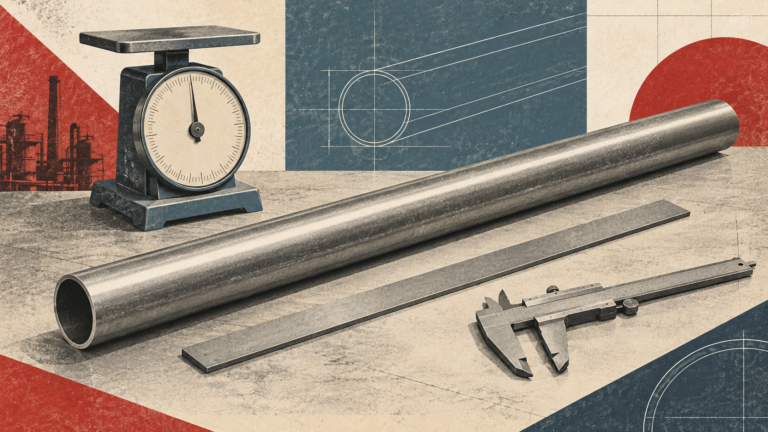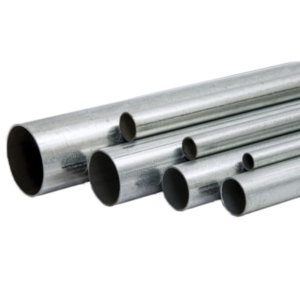
Two lengths of EMT can look similar but behave differently in a hand bender. One bends smoothly; another takes more effort and flattens at the bend. For customers bending conduit on site, that difference matters more than how impressive a grade name sounds.
Based on years of sourcing and bending trials with Q195, DX51D, DX52D and DX53D, our recommendation is clear: for EMT where on-site hand bending matters, start with DX51D as the minimum material choice we recommend, then consider DX52D or DX53D according to size and forming requirements. This is our practical selection advice. Here is the experience behind it and the material data that helps explain the differences.
What have we observed with the four materials?
Q195: a lower purchase cost, but more difficulty with larger hand bends
Among these four materials in our sourcing experience, Q195 has had the lowest purchase cost and the least satisfactory hand-bending performance. EMT made from the Q195 we have used feels stiff in the bender and takes more effort. Larger sizes, particularly ¾-inch and 1-inch tubes, have been more prone to flattening at the bend. We have encountered this repeatedly over years of use and trials.
Some ½-inch Q195 tubes have met our bending requirements, but success at a smaller size has not settled the question for larger tubes. Its advantage is purchase cost; the main drawback in our experience is the difficulty with larger hand bends. This is why we recommend starting with DX51D for customers who prioritise hand-bending performance.
“Feels stiff” describes our bending experience, not a laboratory hardness result. This is also not a judgement of all Q195 steel in every application.
DX51D: our recommended starting point for hand bending
In the finished tubes we have used, moving to DX51D improved hand bending compared with our previous Q195 tubes. That makes DX51D our recommended starting point for these orders: confirm its performance at the customer's actual size, then decide whether DX52D or DX53D is needed.
This is also reflected in our factory's material choices. We generally do not use Q195 for EMT production. Our usual starting point is DX51D, with DX52D or DX53D selected according to the requirements.
Its advantage is the improvement we have observed in use. However, of the three DX grades discussed here, DX51D has the lowest minimum elongation requirement and the widest permitted tensile-strength range. For demanding forming requirements, the grade name alone is not enough; the finished tube still matters.
DX52D: experience with ¾-inch air bending
For customers who frequently hand-bend ¾-inch EMT, we give DX52D particular consideration. Suitable finished tubes have met our requirements for air bending at this size.
Air bending places the bender handle on the ground with the conduit above it. The operator applies force to bend the tube. The instructions for the particular tool should guide its use.
DX52D also has a higher minimum elongation requirement than DX51D. Its limitation is that a successful ¾-inch trial does not establish performance at 1 inch. A different size or bending requirement calls for a corresponding sample comparison.
DX53D: a candidate for demanding forming, with a larger-size example
DX53D has the highest minimum elongation requirement of these three DX grades. We give it early consideration when forming ability matters most, particularly for larger hand-bent conduit.
Mr. Shao previously air-bent 1-inch EMT made with DX53D, with a measured finished wall thickness of 1.45 mm. The process was recorded on video. If you would like to see how this size was bent, contact us to request the video; we can provide it for your reference.
The limitation is that the grade alone cannot guarantee freedom from flattening or wrinkles. If DX51D or DX52D already meets the installation requirement, there is no need to change solely for the DX53D designation. Finished-tube performance at the required size is what matters.
What can the DX material data tell us?
The observations above describe our experience. To compare material requirements, we can also consult published steelmaker data. The table below includes only DX51D, DX52D and DX53D from one source, using the same A80 elongation measure. Q195 is excluded from this numerical table to avoid ranking elongation figures measured on different bases.
| Grade | Tensile strength, Rm | Minimum elongation after fracture, A80 |
|---|---|---|
| DX51D | 270–500 MPa | 22% |
| DX52D | 270–420 MPa | 26% |
| DX53D | 270–380 MPa | 30% |
Source: SSAB's EN 10346 coated-steel data. Testing is transverse to the rolling direction. Minimum elongation falls by two percentage points for thickness 0.50 < t ≤ 0.70 mm and by four points for t ≤ 0.50 mm. These are flat-product values, not acceptance limits for finished welded EMT.
Tensile strength: the maximum engineering stress reached in a tensile test
Tensile strength, Rm, is the maximum test force divided by the specimen's original cross-sectional area, expressed in MPa. For the same original area, a higher measured tensile strength means a higher maximum force was reached. It does not directly specify the force needed to bend conduit.
DX51D's upper limit of 500 MPa does not mean every coil reaches 500 MPa. The three ranges overlap, so their upper limits cannot rank individual batches for bending effort or tensile performance. Yield behaviour, tube dimensions and tooling also matter when assessing the force needed to produce a permanent bend.
Minimum elongation after fracture: how much permanent extension remains
Elongation after fracture is the increase in gauge length, measured with the broken specimen ends fitted together, as a percentage of the original length. A80 denotes an original gauge length of 80 mm. “Minimum” is the specified lower limit, not the fixed result of every coil.
For example, a measured A80 of 30% means that the original 80 mm gauge length becomes 104 mm after fracture and reassembly. This describes the tensile specimen. It does not mean an entire EMT tube can stretch uniformly by 30%, and it cannot be converted into a bend angle.
Under the same test conditions, elongation is a useful indicator of plastic deformation capacity. Minimum A80 rises from 22% for DX51D to 26% for DX52D and 30% for DX53D. The tensile-strength upper limit falls at the same time. Together, these requirements help guide choices where forming ability is important.
They do not, by themselves, establish the cause of the Q195 flattening we have observed or replace finished-tube trials.
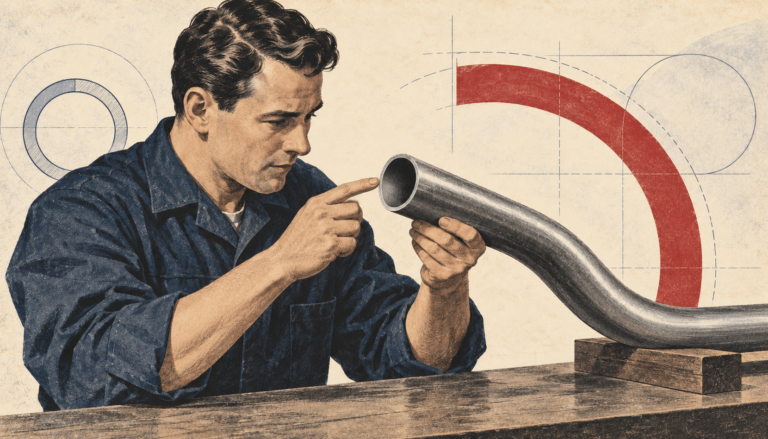
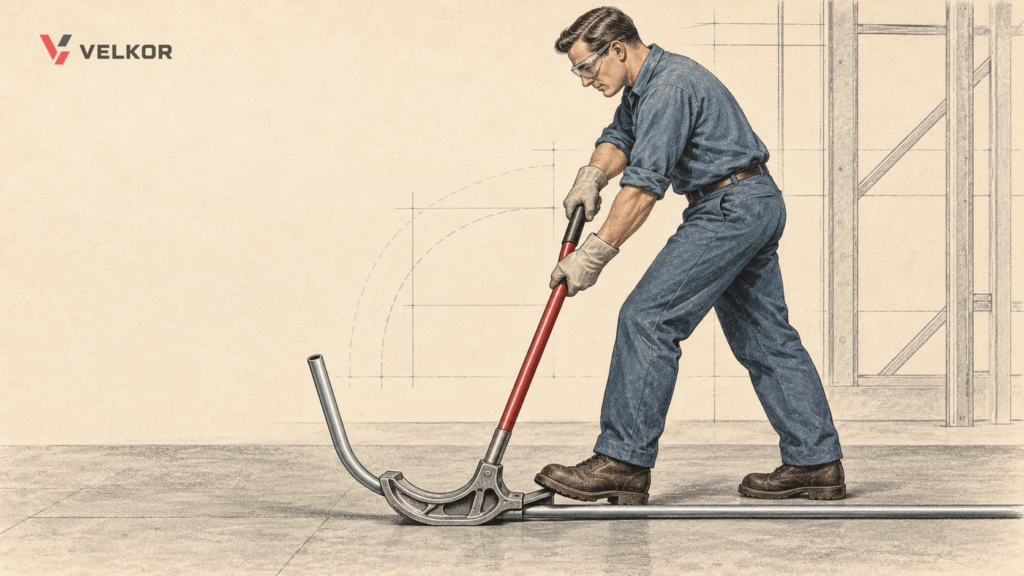
Explore the shape of a bend
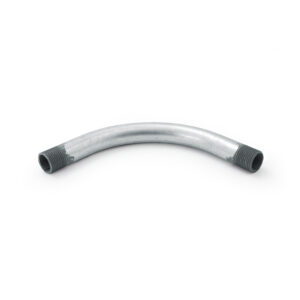
Use the illustration below to recognise different bend shapes. It does not compare steel grades or predict the result of a real bending trial.
Our conclusion: for hand bending, start with DX51D
Our conclusion comes from years of sourcing and bending trials. Of the four materials we have used, Q195 tubes have given us the least satisfactory hand-bending results, with larger sizes more prone to difficult bending and flattening. For EMT that needs good on-site hand-bending performance, we therefore recommend DX51D as the minimum starting point.
For frequent ¾-inch bending, we recommend giving DX52D particular consideration. For 1-inch tubes or more demanding forming, we recommend evaluating DX53D early. These recommendations reflect our experience and specific examples. They are not fixed size limits or guarantees based on the grade name alone.
Compare samples at the size the customer actually needs. A good ½-inch demonstration cannot establish performance for a larger tube.
Keep the finished outside diameter, measured wall thickness, tool, bend angle and radius as consistent as possible. Assess bending effort alongside flattening, wrinkles and cracks. Material, dimensions and tooling can all influence the result. Bend Tooling's technical discussion also emphasises these interacting factors, although its focus is machine bending.
Our advice is to start with DX51D and confirm the choice through finished-tube trials at the required size. The aim is conduit that suits the customer's installation method, backed by performance as well as the material certificate.
In our next article, we will explore how different wall thicknesses affect steel conduit bending when the material stays the same. We will look at bending effort, the shape of the finished bend and selection considerations, bringing material choice and wall thickness into the same discussion.