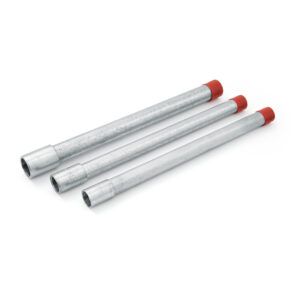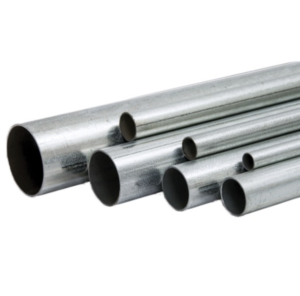

When ordering EMT conduit, one useful question is whether the space left inside the container can actually hold another bundle of pipe. In our loading experience, that depends on the conduit length, bundle size and arrangement—not just the total cubic metres.
With our current large-bundle packing method, a 20-foot standard container reaches a conduit-loading limit of about 21 m³. For 1/2-inch EMT in 3 m lengths, our worksheet gives 38 bundles of 500 pieces, or 19,000 pieces. Suitable spaces can remain for carton-packed fittings, so plan the conduit and cartons together and check the total shipment weight.
How much conduit fits in a 20-foot container?
We adjust the number of pieces per bundle to keep the overall bundle cross-sections approximately similar across pipe sizes. Our current EMT packing is 500 pieces per bundle for 1/2 inch, 300 for 3/4 inch and 170 for 1 inch.
Our factory worksheet uses a maximum of 38 bundles for 3 m EMT, 36 for 3.05 m EMT and 28 for 3 m IMC. Multiplying the pieces per bundle by these bundle limits gives the following single-size loading references.
| Size | EMT pieces / bundle | EMT 3 m pieces / container | EMT 3.05 m pieces / container | IMC pieces / bundle | IMC 3 m pieces / container |
|---|---|---|---|---|---|
| 1/2" | 500 | 19,000 | 18,000 | 500 | 14,000 |
| 3/4" | 300 | 11,400 | 10,800 | 300 | 8,400 |
| 1" | 170 | 6,460 | 6,120 | 200 | 5,600 |
| 1-1/4" | 150 | 5,700 | 5,400 | 150 | 4,200 |
| 1-1/2" | 100 | 3,800 | 3,600 | 100 | 2,800 |
| 2" | 50 | 1,900 | 1,800 | 50 | 1,400 |
Calculation: pieces per bundle × reference bundle limit. For example, 1-inch EMT in 3 m lengths gives 170 × 38 = 6,460 pieces.
These are space-planning calculations based on our packing and loading worksheet, not separately verified physical loads for every size. Each figure represents a container loaded with that one size; do not add the rows together. Actual orders also require a check of the total cargo and packaging weight.
Why can space remain when no more bundles fit?
We begin by placing the conduit bundles lengthwise at the far inside end of the container. As loading progresses, the remaining length is too short to place another 3 m bundle straight. The later bundles are therefore placed diagonally across the floor plane, with both ends at the same height.
Whether the remaining space is useful depends on whether the next long bundle can physically fit into it. A cubic-metre total alone cannot answer that question. Some spaces can accept cartons but cannot accommodate another bundle with the same packing dimensions.
This is why our 20-foot loading worksheet records conduit length, pieces per bundle and the bundle limit. Even for the same 3/4-inch EMT size, the reference is 38 bundles at 3 m and 36 bundles at 3.05 m.
Changing the packing changes the loading quantity
The 38-bundle limit applies to our current large-bundle packing. For 1/2-inch EMT in 3 m lengths, 38 bundles of 500 pieces gives 19,000 pieces. In our loading experience, smaller bundles allow more flexible use of the available spaces and can fit more conduit.
However, a different packing method requires a fresh loading plan. The original large-bundle limit should not be reused for smaller bundles.
When comparing suppliers’ loading quantities, check the conduit type, size and length, the number of pieces per bundle, the packing and loading arrangement, and the combined cargo and packaging weight. Those conditions make the figures meaningful.
Try your 20-foot container order
Select the product and length, then enter the pieces required for each size. The calculator follows our original worksheet to estimate bundle equivalents, conduit occupancy and the remaining carton allowance. You can combine sizes within the selected product group.
Calculator unavailable. The reference table above remains usable without JavaScript. Divide each quantity by its pieces per bundle and add the results, then compare with the selected product’s bundle limit. The 3 m EMT carton formula is shown below.
20-foot standard container · Reference limit: 38 bundles
Uses our stated large-bundle packing. Carton allowance and conduit occupancy are estimates, not a guarantee of physical fit. Check weight separately. A zero-quantity order is not an estimate of empty-container capacity.
The conduit occupancy factors are approximately 0.5526 m³ per bundle for 3 m EMT, 0.5833 m³ for 3.05 m EMT and 0.75 m³ for 3 m IMC. They are calculated as 21 m³ divided by the respective bundle limits; they are not measured bundle volumes.
How much carton space remains after loading the conduit?
We have physically loaded this combination: 25 bundles of 3 m EMT plus 14 m³ of cartons. Our worksheet uses that combination as a reference to estimate the carton allowance as the conduit quantity changes:
Estimated carton allowance (m³) = 14 + (25 − conduit bundles) × 0.56
Increasing the conduit from 25 to 38 bundles adds 13 bundles. The formula gives 14 − 13 × 0.56 = 6.72 m³ of estimated carton space.
The distinction matters: 25 conduit bundles plus 14 m³ of cartons is an actual loading example; 38 bundles plus 6.72 m³ of cartons is a planning estimate. The final carton quantity still depends on carton dimensions and the physical loading arrangement.
For the other two product groups, the calculator preserves the original worksheet formulas: 14 + (24 − bundles) × 0.58 for 3.05 m EMT, and 14 + (18 − bundles) × 0.78 for 3 m IMC. These outputs are estimates; the actual-loading example above applies specifically to 3 m EMT.
If you are ordering conduit and carton-packed fittings together, estimate both before confirming quantities. More conduit means the carton plan needs to be adjusted as well.
Why do we mainly check weight for 40-foot containers?
For the conduit shipments discussed here, our experience is that a 40-foot container usually reaches its allowable cargo weight before the available space is used up. We therefore focus on the weight per piece or bundle when calculating its loading quantity, rather than using this 20-foot space-planning table.
That also means a 40-foot loading quantity cannot simply be calculated by doubling the 20-foot figure. It must be checked against the combined weight of the conduit and packaging, the actual container’s permitted payload and the transport requirements.
A 20-foot shipment also needs a weight check. The table and calculator in this article address space planning under our current packing method; they do not replace that check.
Plan conduit and fittings together before ordering
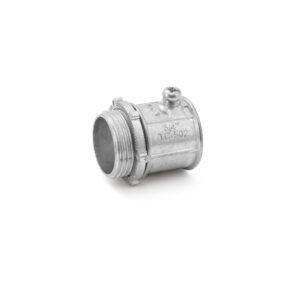
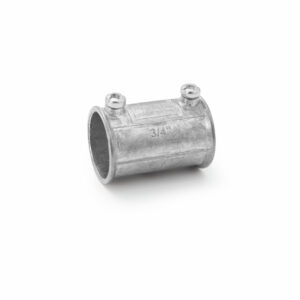
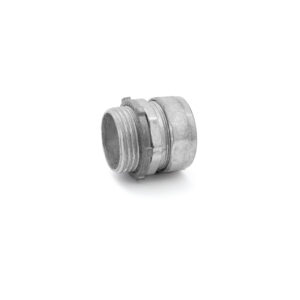
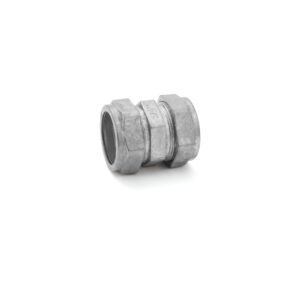
When preparing an EMT conduit and fittings order, provide the conduit type and length, quantities by size, pieces per bundle, carton dimensions and carton counts, and your intended container type.
Convert the conduit quantities to bundles, plan how the bundles and cartons will fit, then check the total shipment weight. This makes it easier to identify which quantities can be retained and which need adjusting before the order is confirmed.
Send us your conduit sizes, lengths, quantities and packing requirements so we can check the loading arrangement for your order.
Loading references and examples: our factory packing worksheet and James’s firsthand loading experience, confirmed in October 2026. Figures apply to the product lengths and large-bundle arrangements described above.